GEOTECHNICAL ENGINEERING1
IPSWICH
HomeFoundationsShallow foundation design

Shallow Foundation Design for Ground Conditions in Ipswich

Sound ground. Sound decisions.

LEARN MORE

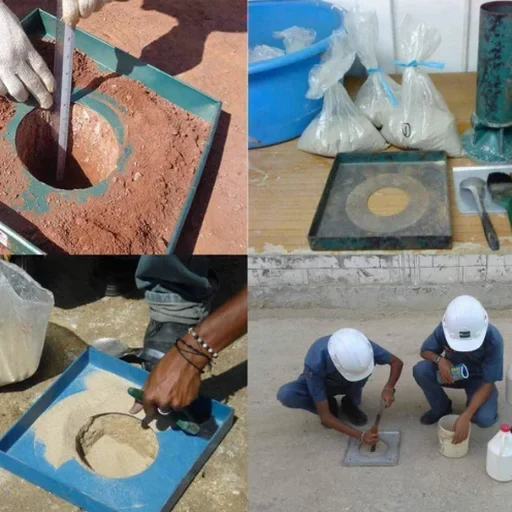
Eurocode 7 leaves no room for guesswork, and in Ipswich the ground doesn't either. BS EN 1997-1 requires design by calculation for bearing resistance and settlement on every project. The challenge here is the Cretaceous Gault Clay, which weathers into a stiff grey-blue material that can soften rapidly when exposed. Our team has carried out shallow foundation design across Kesgrave, Pinewood, and the waterfront regeneration zone. We work directly with structural engineers to define footing geometry, embedment depth, and allowable bearing pressure. A critical step is correlating site investigation data with the Ipswich geological model. For sites where the clay mantle is thin, we often recommend supplementing the desk study with in-situ permeability testing to check drainage behaviour beneath the formation level before finalising the foundation scheme.

A shallow foundation in Ipswich Gault Clay fails by settlement long before it fails by bearing. We design for the millimetres, not the tonnes.
Our service areas

Process and scope

East Anglia's climate shapes foundation performance more than most designers expect. Ipswich sits in one of the drier regions of the UK, with annual rainfall around 570 mm, but the seasonal swing is what matters. Summers bake the near-surface clay into a hard crust. Winters saturate it. That shrink-swell cycle can impose serviceability movements on shallow foundations if the bearing stratum isn't deep enough. We see this pattern repeatedly in the Chantry estate and older Victorian terraces. Our design approach accounts for vegetation influence, desiccation depth, and the plasticity index of the Gault Formation. When the soil profile transitions into the overlying Thames Group sands and silts, differential settlement becomes the controlling limit state. In those mixed profiles we often combine the foundation analysis with a plate load test programme to validate the design parameters on site before the pour.
Shallow Foundation Design for Ground Conditions in Ipswich
Technical reference — Ipswich

Local considerations

A four-storey residential block we reviewed off Felixstowe Road was designed with a uniform 600 mm strip footing bearing at 800 mm depth. The ground investigation missed a lens of soft alluvial clay at the northern corner. Within eighteen months the corner had settled 38 mm, cracking the brickwork and twisting the window frames. The repair involved partial underpinning and cost nearly double the original foundation package. That case underscores the real risk in Ipswich: the Thames Group overlies the Gault Clay in discontinuous lenses across the town, and a borehole spacing of more than 15 metres can easily miss a soft pocket. Our design reviews always check the borehole layout against the British Geological Survey mapping. If the spacing is too coarse, we call for supplementary probes. Shallow doesn't mean simple. It means the failure consequences are concentrated right at the surface.

Need a geotechnical assessment?

Reply within 24h.

Email: contact@geotechnical-engineering1.com

Reference standards

BS EN 1997-1:2004 + UK National Annex (Eurocode 7: Geotechnical design), BS 8004:2015 (Code of practice for foundations), BS 5930:2015 + A1:2020 (Code of practice for ground investigations), BS EN 1990:2002 + UK NA (Basis of structural design, working life)

Reference parameters

ParameterTypical value
Typical footing depth in Ipswich clay0.9 - 1.2 m below ground level
Presumed bearing resistance (Gault Clay, stiff)150 - 250 kPa (BS 8004 indicative)
Allowable settlement (total)25 mm for conventional framed structures
Minimum footing width600 mm (strip), 900 mm (pad)
Design working life (Category 2 structures)50 years per BS EN 1990
Partial factor on permanent actions (A1)1.35 (EQU/STR Set A1)
Partial factor on tan φ' (M1)1.0 (drained conditions)

Frequently asked questions

What is the typical bearing capacity of Gault Clay in Ipswich for a shallow foundation?

For a stiff, intact Gault Clay at 1.0 m depth, the presumed bearing resistance under BS 8004 typically falls between 150 and 250 kPa. The actual allowable bearing pressure depends on the undrained shear strength from site-specific triaxial testing, the footing width, and the embedment depth. We never use presumed values for final design without verification.

How much does shallow foundation design cost for a residential project in Ipswich?

For a single dwelling or small residential extension in Ipswich, the design package including desk study review, bearing capacity and settlement calculations, and a design report typically ranges from £1,510 to £2,250. The final figure depends on the complexity of the ground profile and whether supplementary testing is required.

How deep should strip footings be in Ipswich clay soils?

We specify a minimum depth of 0.9 to 1.2 m below ground level for strip footings in the Gault Clay. This gets below the zone of seasonal moisture fluctuation and desiccation cracking. Proximity to trees can push that depth deeper, in line with the mature tree height guidelines in the NHBC Standards.

What is the difference between bearing capacity and settlement failure?

Bearing capacity failure is a sudden collapse where the ground shears beneath the footing. Settlement failure is slow, progressive movement that damages the structure over time. In Ipswich Gault Clay, settlement governs the design in nearly every case. We calculate both limit states per BS EN 1997-1, but the allowable bearing pressure is almost always controlled by the settlement criterion.

Can you use shallow foundations on the Thames Group sands and gravels in Ipswich?

Yes, the Thames Group sands and gravels found across parts of Ipswich can provide excellent bearing for shallow foundations. The key risk is loose pockets and variable density. We typically recommend dynamic probing or SPT testing to confirm relative density across the footprint before selecting the design bearing pressure.

Location and service area

We serve projects in Ipswich and surrounding areas.

View larger map