GEOTECHNICAL ENGINEERING1
IPSWICH
HomeInvestigationCPT (Cone Penetration Test)

CPT Testing Ipswich: Reliable Cone Penetration Data for Site Design

Sound ground. Sound decisions.

LEARN MORE

The soil conditions shift dramatically as you move across Ipswich. Down by the Waterfront, soft alluvial silts and tidal deposits dominate, remnants of the Orwell’s historical floodplain. Head north towards Whitton or Whitehouse and you hit Anglian glacial till within the first few metres—dense, stony, and entirely different to work with. A standard borehole gives you a snapshot every 1.5 metres, but here that gap can hide a thin drainage layer or a lens of soft clay that changes your foundation design completely. A CPT test closes that gap. It provides near-continuous resistance data, letting you see exactly where the ground transitions, which is critical when a site straddles two distinct geological zones as many Ipswich plots do.

A CPT log gives you a continuous stratigraphic signature that a conventional borehole log, by its nature, can only approximate at discrete intervals.
Our service areas

Process and scope

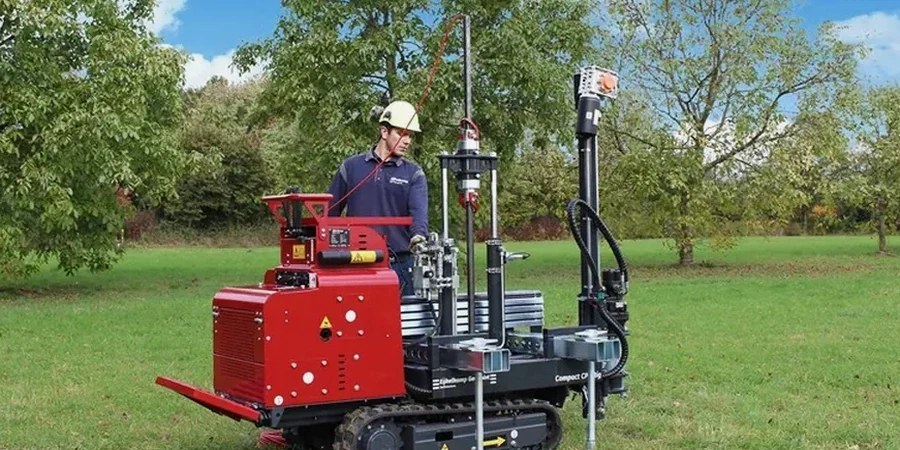
On many Ipswich redevelopment sites we see the same thing: geotechnical data that looks fine on paper but misses a thin peat seam or a water-charged silt band at depth. The CPT cone picks those up immediately through pore pressure response and friction ratio. This isn't just extra data—it's the difference between a pile length estimate that holds and one that needs a costly variation order mid-project. When we push a cone on the east side of town, we often combine it with a grain size analysis to calibrate the sleeve friction against known Ipswich lithology, especially where the Kesgrave sands meet the London Clay. For deeper developments near the town centre, the CPT trace can also feed directly into a seismic microzonation model, providing shear wave velocity estimates without the need for a separate downhole survey.
CPT Testing Ipswich: Reliable Cone Penetration Data for Site Design
Technical reference — Ipswich

Local considerations

The mistake we keep seeing is a design team relying solely on SPT N-values for a site that sits on the Orwell alluvium. N-values don't capture the collapse potential of some of the softer silts found along the river corridor, and they completely miss the thin sand laminations that can act as drainage paths and accelerate consolidation settlement under load. A CPT cone measures pore pressure dissipation directly. You can watch excess pressure bleed off in real time. Without that, you risk a foundation that settles differentially over five years, cracking brickwork and racking door frames—a problem that shows up long after the groundworks contractor has left. For sites within the Ipswich borough that sit on the London Clay, undrained shear strength derived from a CPT is simply more reliable than correlations from an SPT hammer.

Need a geotechnical assessment?

Reply within 24h.

Email: contact@geotechnical-engineering1.com

Video resource

Reference standards

BS EN ISO 22476-1:2012 (Cone Penetration Test), BS 5930:2015 + A1:2020 (Site Investigation Code of Practice), Eurocode 7: BS EN 1997-2:2007 (Ground Investigation)

Reference parameters

ParameterTypical value
Cone capacity (electric)10 t (standard push)
Depth rangeUp to 25 m in typical Ipswich till
Parameters recordedqc, fs, u2, Rf, Bq
Data sampling rateEvery 10 mm (standard)
ComplianceBS EN ISO 22476-1
Reporting standardBS 5930:2015 + A1:2020
Typical push rate20 mm/s ± 5 mm/s

Frequently asked questions

Can you push a CPT cone through the chalky till common in north Ipswich?

The Anglian till here contains chalk clasts and occasional cobbles. We use a pre-drilled pilot hole through the most stubborn upper metre if needed, then push the cone through the underlying matrix. If the cone refusal risk is high, we recommend a combined approach: CPT for the softer layers, supplemented by rotary coring for the very dense zones.

What does a CPT test around Ipswich typically cost?

For a standard piezocone test up to 20 metres depth, budget between £120 and £180 per push, which includes mobilisation of the 10-tonne rig, data acquisition, and a processed log with soil behaviour type classification. The total cost depends on the number of pushes and whether you add seismic or dissipation testing.

How quickly do you deliver the CPT data after a site visit?

Raw data is available on the rig screen in real time. The processed CPT log with soil behaviour type classification, friction ratio, and pore pressure plots is typically emailed within 48 hours of the field work. Faster turnaround is possible if the design team is waiting to finalise pile lengths.

Do you need a separate borehole if you perform a CPT?

A CPT does not recover a physical sample, so we still recommend at least one borehole or test pit on site to calibrate the cone response against the actual Ipswich lithology. The combined approach gives you both the continuous profile from the CPT and the visual classification from the borehole log, aligning fully with BS EN 1997-2 requirements.

Is CPT suitable for the soft ground near the Ipswich Waterfront?

Yes. In fact, the soft alluvial silts and peats along the Orwell corridor are where CPT provides the greatest value over SPT alone. The cone gives you a continuous undrained shear strength profile and identifies thin permeable layers that control the rate of consolidation—information that directly feeds settlement calculations and ground improvement design.

Location and service area

We serve projects in Ipswich and surrounding areas. More info.

View larger map